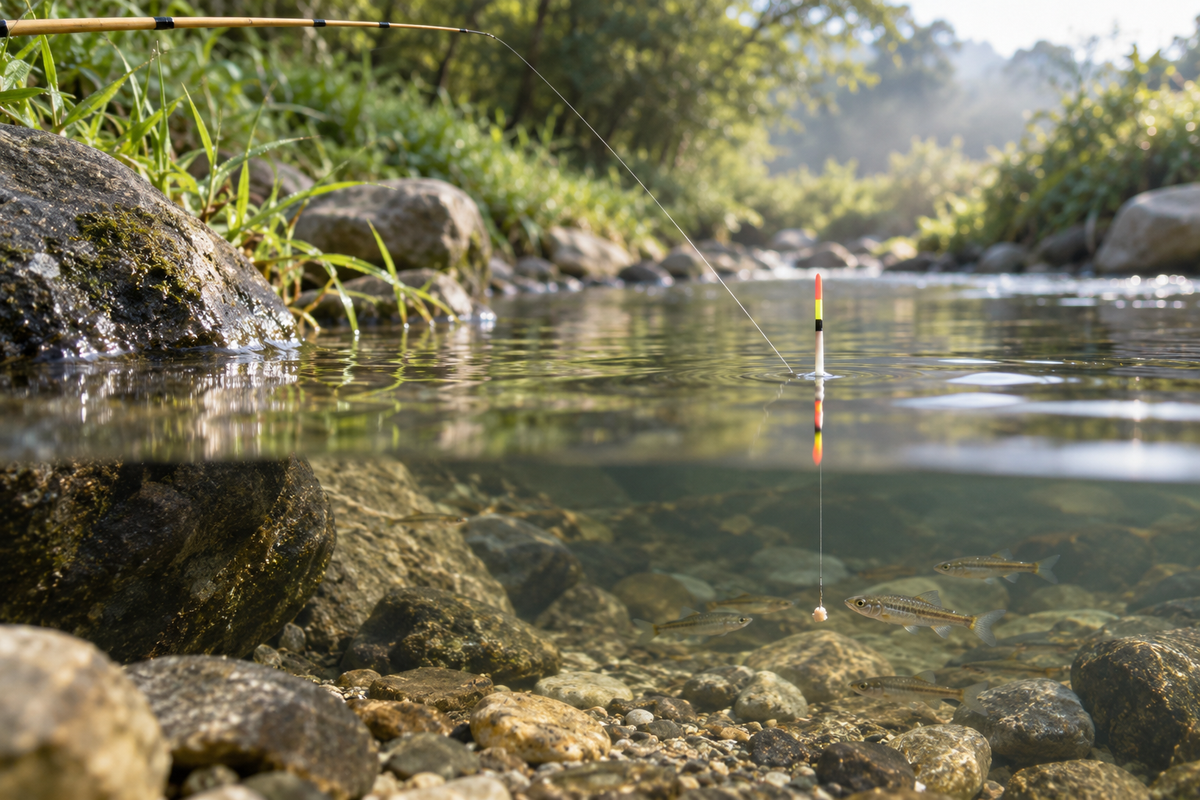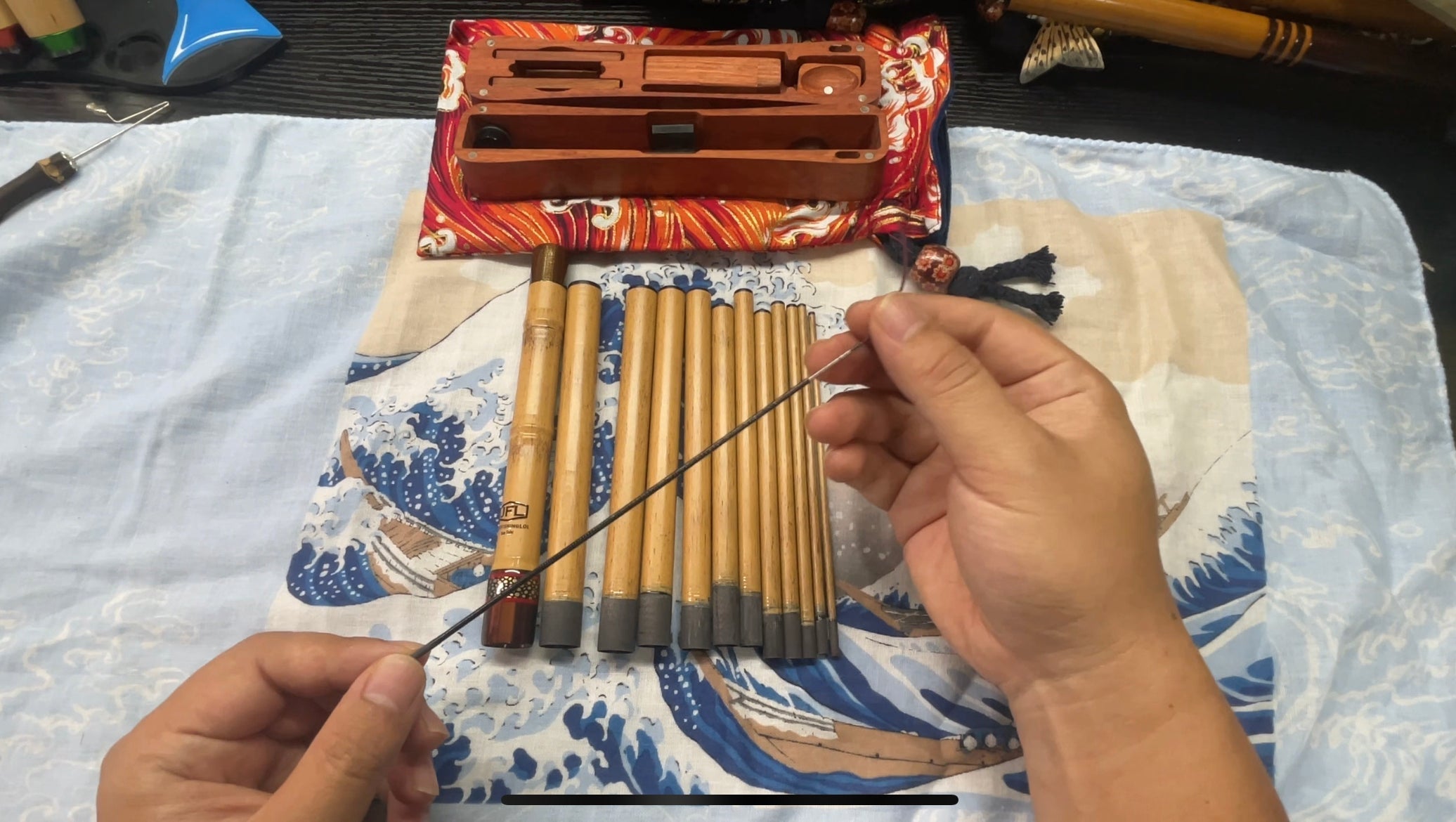

I've been fishing Tanago for about five years. When I started, I knew almost nothing about hook shapes, line sizes, rigs, or the tiny fish living in the creeks and ponds around me.
Tanago fishing arrived during a difficult period in my life. Watching a tiny float beside a small piece of water gave me somewhere useful to put my attention. It later led me into Tenkara, lure fishing, light rock fishing (LRF), and a much deeper interest in bitterlings, minnows, gobies, and other overlooked small-water species.
Today, I also share it with my son and friends. A tiny fish on a tiny rod is often enough to make everyone smile.
The four patterns below are not catalog choices. They are hooks I actually keep in my fishing box.
And after five years, one lesson keeps coming back:
The smallest hook isn't always the best hook.
A better hook is the one that makes sense for the fish you're actually trying to catch.

Quick Answer: Which Tanago Hook Should I Use?
If you don't want to read the whole guide yet, this is the simplest way I personally use these four patterns:
| Hook | Where I Use It Most | Main Advantage |
|---|---|---|
| Shin-Hangetsu / New Half Moon | Juvenile or sub-adult bitterling and exceptionally tiny-mouthed fish | Ultra-short hook point |
| Akita Fox #0.8 | Adult bitterling, small gobies and medium-sized micros | Compact middle-ground geometry |
| Sode #0.5 | Everyday micro fishing and slightly larger small fish | Longer point, good holding ability and easy handling |
| Sode #0.8 | Small sunfish, juvenile tilapia and larger micros | More working hook and versatility |
These are not hard limits.
A New Half Moon can absolutely catch a larger fish. A Sode hook can still catch something very small.
The point of changing hooks isn't to decide which fish a hook is "allowed" to catch.
The better question is:
Which hook gives me the best characteristics for the fish I'm actually targeting?
That's the difference between simply using a small hook and fishing more deliberately.
If you want to carry the same four options and change the replacement hook section according to the fish you're targeting, see our Pre-Tied Tanago Hooks – 4 JFL-Recommended Patterns.
Why Tanago Hook Size Is So Confusing
One of the first mistakes I made was looking at the number printed on a hook package and assuming it told me how small the hook really was.
It doesn't.
Different hook patterns can have very different hook-point lengths, gape widths, shank lengths, bends, and overall proportions.
For extremely small fish, hook-point length can matter more than the total size of the hook. For a broader introduction, start with our What Is Microfishing? guide. If you are choosing a complete setup, browse our Tanago rods.
That's one of the unusual things about true Tanago hooks.
The fish doesn't necessarily need to take the entire hook into its mouth. The important part is the working point that needs to enter the mouth and make contact.
TenkaraBum's long-running English-language micro-fishing hook guide makes the same distinction: for exceptionally tiny mouths, point length can be more useful than comparing the hook by conventional Western overall size.
That is also why I don't like saying something like:
"This Tanago hook is basically a Western #28."
It may sound convenient, but the shapes are too different for that comparison to tell the full story.
In Tanago fishing:
Look at the hook point, not just the number.

1. Shin-Hangetsu / New Half Moon
When the Fish's Mouth Is the Real Problem
The Shin-Hangetsu, or New Half Moon, is the most specialized of these four when I'm dealing with exceptionally small mouths.
The defining feature isn't simply that the hook is tiny.
It's the very short hook point.

Imagine a juvenile bitterling trying to take a normal small hook.
The hook may look tiny in our hand, but if the point is still relatively long, there simply may not be enough room inside that little mouth for the working section of the hook.
That's the problem the New Half Moon solves.
For me, it is particularly useful for juvenile bitterling, sub-adult bitterling, very small fish with narrow mouths, and fish that are clearly taking the bait but struggling to take a longer hook point.
This isn't just a theoretical idea. OWNER's Migen (Micro) Tanago hook uses the New Half Moon shape and describes an extremely shortened point specifically for very small young Tanago. That manufacturer description lines up closely with what I see on the water.
Source: OWNER — Migen (Micro) Tanago
I'm not choosing the New Half Moon because I want to say:
"This is the smallest hook in my box."
I'm choosing it because:
I need less metal to enter the fish's mouth.
That's a much more useful way to think about it.
Can a New Half Moon Catch Bigger Fish?
Absolutely.
I'm not saying a New Half Moon can only catch juvenile bitterling.
The issue is optimization.
Once the fish's mouth is large enough to comfortably take a longer point, the ultra-short point is no longer solving the main problem. At that point, another hook may give me more working area, better retention, or easier handling.
So for me:
The New Half Moon is a solution to an extremely small-mouth problem—not automatically the best hook for every small fish.
The version shown here is also barbed, which can help keep a fish attached once hooked. The trade-off is that I take extra care when removing it from very small, delicate fish.
2. Akita Fox #0.8
The Middle Ground
If the New Half Moon sits at the extreme-small-mouth end of my hook box, Akita Fox #0.8—an Akita Kitsune-pattern hook—is usually my next step up.
Its point is not extremely long, but it is not as specialized and short as the New Half Moon. The point also sits slightly farther forward/outward.

Daiwa describes the Akita Kitsune as being similar to a Sode hook but with the point facing farther outward, helping it hook small fish effectively. Daiwa also notes that the pattern is commonly used for very small fish such as wakasagi.
Source: Daiwa — Hook Guide
In my own fishing, that makes it a very useful middle-ground option.
I particularly like it for adult bitterling, small gobies, and other micro species that are no longer tiny juveniles but still have relatively small mouths.
The Trade-Off: Mine Is Barbless
The Akita Fox #0.8 shown here is barbless.
If a fish starts twisting, shaking, or violently moving its body, a barbless hook has a greater chance of coming free. With such small tackle, keeping steady tension on the line becomes important.
But the upside is something I value a lot:
removing the hook is generally quicker and easier.
With a small hook remover, I can usually release the fish very quickly without having to work a barb back through the mouth.
Sometimes I lose a fish. That's okay.
For me, an easy release is often worth it.
It's my middle-ground hook: small enough for true micro fishing, less extreme than the New Half Moon, and very convenient when quick release matters.
3. Sode #0.5
My Everyday Micro-Fishing Option
Once I'm targeting slightly larger small fish, I start moving toward Sode hooks.
The working point is longer, and the overall shape starts to look more like what many anglers think of as a conventional small hook.

A longer point would be a disadvantage if a juvenile bitterling couldn't get it into its mouth.
But once the fish is large enough to comfortably take that point, the extra working length becomes useful.
Daiwa describes Sode hooks as suitable for small fish and notes that their longer shank also makes them easier to remove when a fish takes the hook deeper.
Source: Daiwa — Hook Guide
That matches what I like about them.
In my experience, Sode hooks give me a good combination of solid holding ability, easy hook removal, easier baiting, and easier handling.
My Sode #0.5 is also barbless, so I still get the quick-release advantage I like, while the longer working point gives me more hook once the fish is large enough to take it.
Why I Like It for General Micro Fishing
I've brought my son and several friends into Tanago and micro fishing.
That taught me something I didn't think much about when I started:
the technically smallest hook isn't always the best hook to give a beginner.
If they can barely see it, struggle to bait it, and spend more time fighting the tackle than watching the water, you're making the experience harder than it needs to be.
That's why the Sode #0.5 has become a useful everyday option for me.
It gives me a nice balance between:
finesse, holding ability and usability.
If you're still building your first complete setup rather than just choosing a hook, my beginner micro fishing setup guide explains how the rod, line, float, hook and bait work together.
4. Sode #0.8
For Slightly Larger Micros and Mixed Water
The Sode #0.8 is where I step when I'm expecting somewhat larger small fish.
That may include small sunfish, juvenile tilapia, larger gobies, larger minnows, and other small fish that no longer have true Tanago-sized mouths.

Once a fish has enough mouth space to comfortably take the longer point, that extra working hook is no longer a disadvantage.
It can become an advantage.
Sometimes I know exactly what I'm targeting.
Other times I stop beside a creek simply because I want to know:
What's living in there?
When I don't know whether the next fish is going to be a small goby, a minnow, a juvenile sunfish or something else entirely, I don't necessarily want the most specialized hook in the box.
I want something forgiving.
That's where the Sode #0.8 earns its place in my kit.
If you want to switch between these four hook styles without rebuilding the whole rig every time, this is why I keep pre-tied Tanago replacement hook lines ready in my box.
Don't Choose a Hook by Fish Size Alone
It's tempting to simplify hook selection into:
Small fish = small hook.
Larger fish = larger hook.
After five years, I think that's too simple.
The real decision involves fish-mouth size, hook-point length, gape, barb versus barbless construction, how aggressively the fish fights, how easily you want to release it, and the size of the bait you're using.
Daiwa's general hook guide makes a similar broader point: shorter hook proportions tend to suit smaller fish, while more working length becomes useful as target size increases.
Source: Daiwa — Hook Guide
But these are still not hard boundaries.
A New Half Moon can catch a sunfish. An Akita Fox #0.8 can catch a juvenile bitterling. A Sode can catch something smaller than you might expect.
Hook choice is about optimization, not permission.
Sometimes the Hook Isn't the Problem. The Bait Is.
You buy an extremely small Tanago hook... and then cover most of it with bait.
Now the fish isn't meeting the hook point. It's meeting a cushion of bait.
With hooks this small, bait size becomes part of hook geometry.
If I'm getting repeated bites but can't connect, I don't automatically switch to a smaller hook.
I check the bait first.
Use enough bait for the fish to find it, but not enough to stop the hook from doing its job.
A Counterintuitive Tanago Rule: Why My Hook Line Is Thinner Than My Main Line
Here's something that feels completely backwards if you come from lure fishing.
In lure fishing, we're often used to using a heavier or more abrasion-resistant leader because it may rub against rocks, wood, shells, vegetation, or other structure.
In my Tanago rigs, I often do almost the opposite.
When I build a rig myself, I commonly use around 0.6–0.8-gou fluorocarbon for the main body of the rig. Gou is the Japanese line-size rating; it is not a millimeter measurement.
The hooklength—the short leader section tied directly to the hook, also called a replacement hook line—may be only:
0.3-gou.
So yes:
the line nearest the hook is deliberately thinner.
Why Would I Make Part of the Rig Weaker?
Because a Tanago rod is extremely light and delicate.
If I accidentally hook a much larger fish—or become badly snagged—something eventually has to give.
For me, the thinner 0.3-gou hook line works almost like a fuse.
The thinner hook line isn't a flaw in the rig. It's a controlled weak point that helps protect everything above it.
Under extreme load, I would much rather lose one tiny hook and its short line than risk a delicate Tanago rod tip and the entire rig.
OWNER's current Tanago float rig also pairs 0.4-gou main line with 0.3-gou hooklength.
Source: OWNER — Tanago Float Rig
My own main body is often 0.6–0.8-gou fluorocarbon.
The important idea is the relationship between the two.
Tanago Hooks Are Consumables
I treat the hook and its short line as a consumable part of the rig.
If you come from lure fishing, I think of it a little like jigheads and soft plastics.
Sometimes you damage one. Sometimes you lose one. You replace it and keep fishing.
Losing a tiny hook isn't ideal. Breaking a favorite Tanago rod is much worse.
Tanago Hook Size Reference
If you want one image to save for later, this is the short version of the entire guide:

Image reuse note: This reference image may be quoted or shared for educational use with visible attribution to JUSTFISHINGLOL and a link back to this guide.
What Five Years of Tanago Fishing Has Taught Me
When I struggle to hook a fish, I no longer ask only which hook is smallest. I ask:
What is stopping this particular fish from taking my bait properly?
Its mouth may be too small, the point too long, a barbless hook may be coming loose, or the bait may be covering too much of the working point. Tanago fishing taught me to slow down, watch carefully, and change one variable at a time.
My Simple Tanago Hook Selection Rule
Exceptionally tiny mouth
Shin-Hangetsu / New Half Moon
Especially juvenile and sub-adult bitterling.
Adult Tanago and medium micros
Akita Fox #0.8
My middle-ground option for adult bitterling, small gobies and similar fish.
General micro fishing
Sode #0.5
A balance of finesse, holding ability and easy handling.
Larger micros or mixed water
Sode #0.8
For small sunfish, juvenile tilapia and situations where I don't know exactly what will bite.
These are starting points, not rules.
Frequently Asked Questions About Tanago Hooks
What makes a Tanago hook different from a normal small fishing hook?
The biggest difference is not necessarily total hook size. For extremely small fish, point length and hook geometry can be more important because only the working portion of the hook needs to enter the mouth.
Is the smallest Tanago hook always better?
No. An ultra-short point is useful when the fish's mouth is the limiting factor. Once the fish can comfortably take a longer hook point, another pattern may offer more working area, better holding characteristics or easier handling.
What is a New Half Moon hook best for?
In my own fishing, I particularly like it for juvenile and sub-adult bitterling and other fish with exceptionally small mouths.
What is an Akita Fox or Akita Kitsune hook used for?
I use it as a middle-ground Tanago hook for adult bitterling, small gobies and similar micros.
Are barbless Tanago hooks better?
Not automatically. Barbless hooks are quicker and easier to remove, especially with a hook remover, but a twisting or violently shaking fish may also throw the hook more easily. It's a trade-off.
Can I catch sunfish with a New Half Moon?
Yes. The recommendations in this article describe where I find each hook most useful, not the only fish each hook can catch.
Why is the Tanago hook line thinner than the main line?
In my rigs, the thinner hook line creates a predictable weak point. If I hook an unexpectedly large fish or become badly snagged, I'd rather sacrifice a tiny hook and short section of line than damage a delicate rod.
Which Tanago hook should a beginner start with?
For general micro fishing, the Sode #0.5 is a comfortable starting point for many situations. If the target fish has an exceptionally tiny mouth, move toward the New Half Moon.
Final Thoughts
Five years ago, I did not expect a Tanago hook to lead me into several other forms of fishing or become something I would share with my son and friends.
You do not need a boat, a huge lake, or a trophy fish. Sometimes all you need is a tiny rod, a tiny hook, a little bait, and enough curiosity to stop beside an ordinary-looking creek and wonder:
What's living in there?
I carry all four because each gives me another way to respond when the fish tell me that what I am doing is not quite right—not because every angler must own four patterns.
If you're just getting started, don't worry too much about finding the perfect hook on your first day.
Start with something manageable. Use less bait than you think you need. Watch the fish. Pay attention. Then change one small thing at a time.
That's how I learned.
If you want to try the four patterns used in this guide, see our Pre-Tied Tanago Hooks – 4 JFL-Recommended Patterns.
Tiny Fish. Big Adventures.
About the Author & This Guide
I've been fishing Tanago for about five years. I started with almost no fishing experience, and Tanago fishing eventually led me into Tenkara, lure fishing, light rock fishing and a much broader interest in small-water fishing.
Today, it's also something I share with my son, friends and the JUSTFISHINGLOL community.
The hooks photographed in this article are hooks I actually use. I photographed them beside a grain of rice and together on the same measurement surface because I think real-world visual comparison is much more useful than relying only on hook-size numbers.
The recommendations in this guide are based primarily on my own fishing experience. Where I discuss established Japanese hook geometry or commercial rig specifications, I cross-checked those observations against manufacturer references and specialist micro-fishing resources.
I don't consider any of these four hooks universally "best."
They're simply four hooks that have earned a place in my own fishing box.
Sources & References
- Daiwa — Hook Guide: Tanago, Sode and Akita Kitsune characteristics
- OWNER — Migen (Micro) Tanago: ultra-short New Half Moon point for very small Tanago
- OWNER — OH Tanago New Half Moon: pre-snelled 0.3-gou hooklength
- OWNER — Tanago Float Rig: 0.4-gou main line / 0.3-gou hooklength
- TenkaraBum — Micro Fishing Hooks: why hook-point length matters